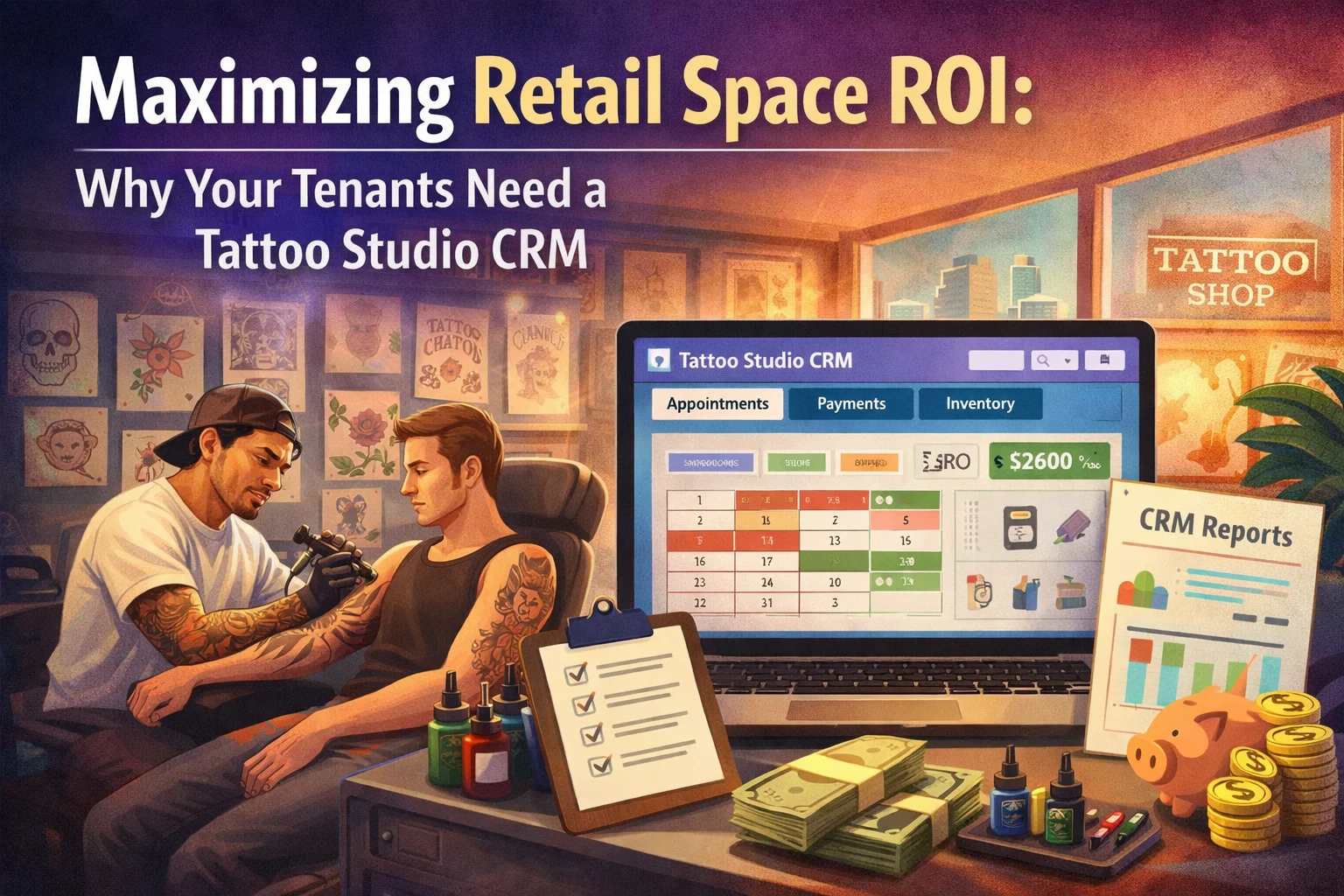
Street-level retail has changed. The dry cleaners and discount apparel chains that once filled these units have thinned out, and what replaces them tends to be experiential — businesses people travel to deliberately rather than wander into.
Boutique tattoo studios sit squarely in that category, and a good one can be an excellent tenant. But "can be" is doing real work in that sentence. The variance between a well-run studio and a poorly run one is wider than in almost any other retail category, and the usual vetting tools don't capture it well.
Here's what actually distinguishes the two, and where operational software fits into the picture — including where it doesn't.
Why the Category Is Worth Considering
Set aside outdated assumptions about the industry. The relevant characteristics for a landlord are structural:
These are destination businesses. Clients book weeks or months ahead and travel to a specific artist. That means the tenant is far less dependent on your building's footfall than a coffee shop or a convenience retailer — useful in a secondary location, and it means a downturn in general retail traffic doesn't hit them directly.
The average transaction is large. Custom work runs to hundreds or thousands of dollars per session, with multi-session pieces extending over months. Revenue per square foot can be strong relative to comparable retail.
Client relationships are durable. People return to the artist who did their previous work. A studio with an established client base has genuine switching costs working in its favour.
Fit-out is substantial. Plumbing, ventilation, partitioned stations, sterilisation areas. A tenant who has invested heavily in a build-out has strong reason to stay and renew — which is exactly what you want.
That last point cuts both ways, and it's worth being clear-eyed: heavy fit-out also means a harder re-let if things go wrong. Which is why the vetting matters.
Where Studios Actually Fail
Tattoo studios rarely fail because demand disappears. They fail on operations. Three patterns recur:
Scheduling collapse
A studio with several artists is managing an unusually complex calendar. Sessions run four to eight hours. Large pieces need multiple bookings spaced weeks apart. Artists work different days. Consultations, walk-ins and touch-ups compete for the same chairs.
Run that on a paper diary and a shared Instagram inbox and things break. A double-booked six-hour session means a lost client, a refunded deposit, and an artist idle for a day. Repeated across a few artists over a few months, the shortfall reaches the rent.
No-shows with no deposit policy
This is the sharpest exposure in the business. A client who fails to appear for a four-hour slot costs the studio the entire day's revenue for that chair, with no recovery.
Studios that take a non-refundable deposit at the point of booking absorb this. Studios that don't are running with no buffer against the most predictable problem they have.
Artist churn
The under-discussed risk. Most studios operate on booth rent or a percentage split, and artists bring their own clients. When a productive artist leaves — often taking their book with them — a meaningful share of studio revenue can walk out with them.
A studio dependent on one or two artists is a concentration risk dressed up as a business. Ask about tenure and payout structure.
Where Booking and Client Management Software Fits
Purpose-built studio management systems address the first two problems directly. They handle multi-session scheduling across several artists, take card deposits at booking, send automated reminders, store consent forms and artwork files, and track the booth-rent or split calculations that generic tools handle badly.
General salon software often struggles here, because it assumes a one-hour appointment with a fixed price. A three-session piece spread across four months with staged deposits doesn't fit that model.
Now the honest caveat, because this is where the usual version of this argument overreaches.
Software is a signal, not a guarantee. A studio can subscribe to an excellent system and still not enforce its deposit policy, still let artists book outside it, still fail on cash flow. Conversely, a two-artist shop with a disciplined owner and a well-maintained spreadsheet can run tightly for years.
What the software tells you is that the owner thinks about operations as a system rather than improvising daily. That is genuinely predictive. It is one signal among several — not a substitute for financials.
What to Actually Ask For
Ordered roughly by how much they tell you:
- Twelve to twenty-four months of financials. Nothing substitutes for this. You want revenue trend, owner's draw, and existing debt service.
- Personal guarantee and its backing. On a boutique tenant, the guarantee is the covenant. Check what stands behind it.
- Artist roster with tenure and payout structure. How many artists, how long each has been there, booth rent or split. This surfaces the concentration risk.
- Current forward bookings. A studio booked eight weeks out has demand. One booked eight days out is living hand to mouth, whatever the annual revenue says.
- Deposit policy, in writing. Amount, refundability, enforcement. Ask what percentage of bookings actually no-show.
- Licences and health department records. Practitioner licences, bloodborne pathogen certification, most recent inspection outcome.
- Insurance certificates. General liability plus professional liability. Confirm limits before signing, not after.
- Operational systems. Which booking and client management platform, and whether deposits are actually collected through it.
Note where the software question ranks. It's informative. It's eighth.
Zoning and Permitting: Do This First
This deserves more prominence than it usually gets, because it can end the deal outright.
Many municipalities restrict body art establishments by zone, and some impose distance requirements from schools, places of worship or other studios. Some require a conditional use permit with a public hearing. Requirements vary enormously between jurisdictions and change over time.
Confirm permitted use with your planning department before executing a lease. Not after, and not on the tenant's assurance. If a permit is needed, build the timeline and a contingency into the lease — a tenant paying rent on a space they can't legally operate in becomes your problem quickly.
Where a hearing is required, documented operating protocols help: sterilisation procedures, waste disposal contracts, age verification, consent records. A tenant who can produce these on request is a tenant who will handle the hearing well.
One correction on framing worth making: tattoo studios are health-department regulated establishments, not medical facilities. Overstating this to a planning board or an insurance broker is more likely to damage your credibility than help your case. The accurate description is strong enough.
Lease Structure Considerations
Under a triple net structure, the tenant carries taxes, insurance and maintenance on top of base rent. That total obligation is what they must cover — and it moves with tax assessments and insurance markets.
A few points specific to this tenant type:
- Model the full occupancy cost against realistic revenue, not gross rent alone. Studios with strong topline can still be tight on NNN.
- Address the fit-out explicitly. Plumbing, ventilation and partitions are significant improvements. Agree in writing who pays, what happens at expiry, and what must be removed.
- Check your insurer early. Some carriers price body art establishments differently or exclude them. Better to know at heads of terms.
- Consider a personal guarantee that steps down after a period of demonstrated performance. It protects your early exposure while giving the tenant something to work toward.
The Bottom Line
A well-run tattoo studio can be one of the more stable boutique tenants available: destination-driven, high average transaction, loyal clientele, and heavily invested in the space.
The variance is the issue. And the factors that separate the good from the fragile are operational rather than financial — deposit discipline, scheduling infrastructure, and how many artists the revenue actually depends on.
Ask about the booking system, by all means. It tells you something real about how the owner thinks. Just don't let it stand in for the financials, the artist roster, or the call to your planning department.
Common Questions
Is a tattoo studio a good retail tenant?
It can be. Strong revenue per square foot, destination traffic, high renewal likelihood given fit-out investment. The risks are artist concentration and operational discipline, both of which are checkable before signing.
Should a tenant's software affect my leasing decision?
Treat it as a signal of operational maturity, not as underwriting. It sits alongside financials, guarantee backing and forward bookings — it doesn't replace them.
What's the most overlooked risk?
Artist churn. A studio's revenue often follows individual artists rather than the business. Ask how many artists, how long they've been there, and what share of revenue the top earner represents.
What should I check before anything else?
Zoning and permitted use. It's the item most likely to kill the deal, and the cheapest to check.
Does documentation help with permitting?
It helps. Sterilisation logs, consent records, waste disposal contracts and age verification procedures demonstrate a professionally run operation to planning boards and insurers. Describe it accurately — a regulated establishment, not a medical facility.
General information for commercial property owners, not legal, tax or investment advice. Zoning, licensing and health regulations for body art establishments vary significantly by jurisdiction — verify current local requirements with your planning department and take professional advice before executing a lease.