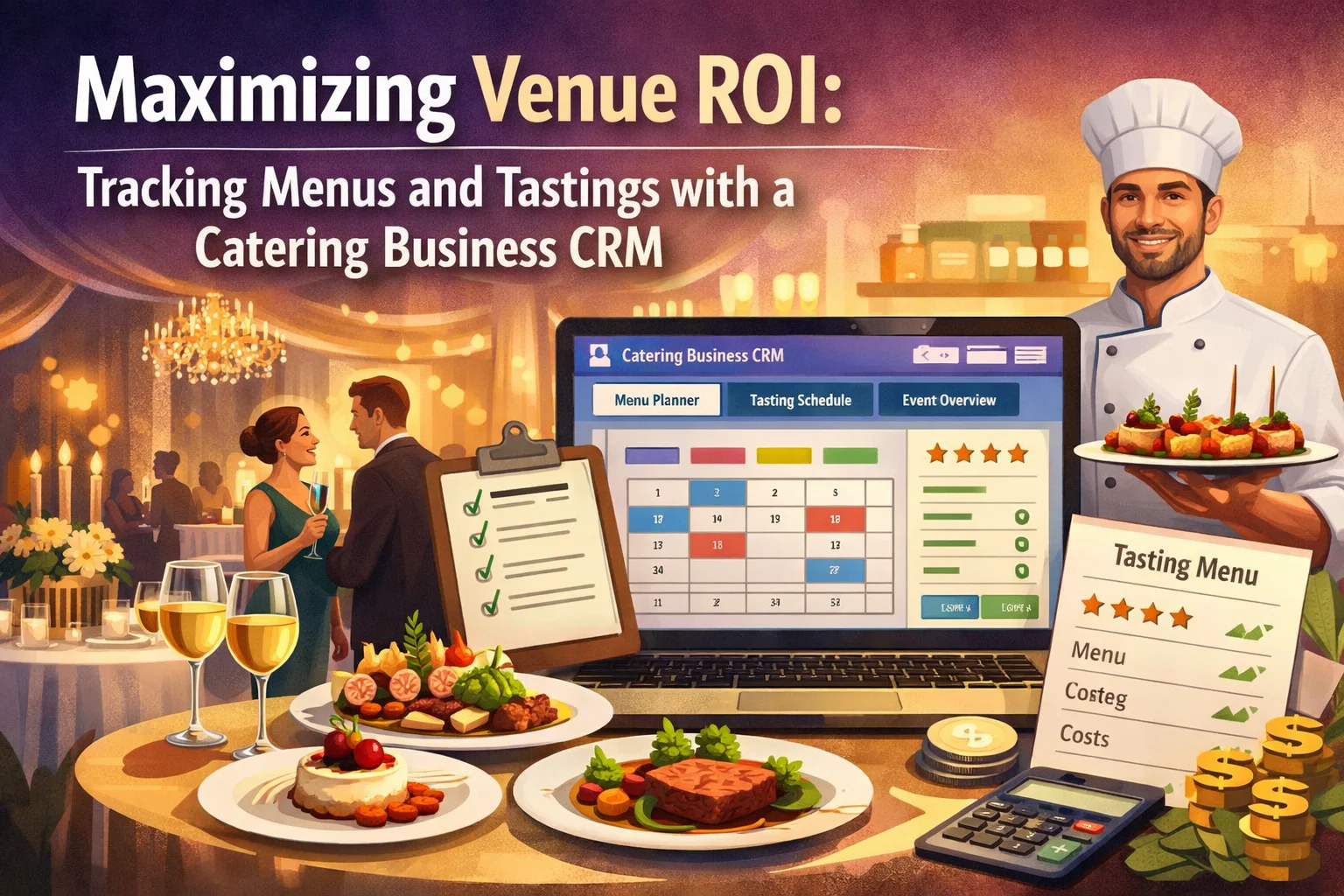
Buying a building and converting it into an event space looks like a real estate transaction. Operationally, it isn't. The moment you take a deposit for a wedding, you have entered the hospitality business — and hospitality fails in ways property investing does not prepare you for.
The failures are rarely dramatic. Venues don't usually collapse because of one catastrophic event. They underperform because of small, repeated leaks in how food and beverage is quoted, tracked and billed. Those leaks are worth understanding before deciding what software, if any, to buy.
The Four Places Venue F&B Loses Money
Unbilled changes
This is the largest and least visible leak.
A contract is signed in March for an October wedding. Between those dates the guest count moves three times, a vegan option is added for four people, the couple upgrades the bar package, and someone requests a late-night food station. Each change was agreed verbally or by email. Some make it onto the final invoice. Some don't.
Nobody steals anything. The venue simply delivers more than it charges for, repeatedly, across every event. Over a year of bookings the cumulative amount is usually far larger than owners expect — and because it never appears as a cost, it never shows up in the accounts as a problem.
Quoting without knowing your margin
A per-head price is easy to quote and hard to check. When a client asks to swap a menu item, the honest answer is often a guess, because nobody can see the plate cost of the alternative in the moment.
Consistently quoting a few percent low on a substantial event is the difference between a healthy year and a flat one.
Forecasting from the wrong number
Ordering to the contracted guest count rather than realistic attendance produces waste at every event. Ordering too tight produces the one thing clients genuinely never forgive: running out.
Venues that track actual versus contracted attendance across past events order far more accurately than venues that don't. This is one of the clearest arguments for keeping structured records of any kind.
Tastings that don't convert
The tasting is the closing meeting, and it's expensive to host — food cost, kitchen time, and a senior person's afternoon.
A tasting where feedback is captured properly and a revised proposal arrives the same day converts noticeably better than one where notes sit on a legal pad and the follow-up takes a week. By then the couple has visited two other venues.
Allergens: A Separate Category Entirely
This deserves its own section, because framing it as a software feature understates it.
An allergen error can hospitalise or kill a guest, and it carries serious legal and insurance consequences for both the caterer and the venue. Software that flags a severe allergy on a guest profile is useful — but the flag is not the safeguard.
The safeguard is an operational protocol: a documented chain from client disclosure to kitchen to the person carrying the plate, separate preparation where required, staff trained to answer ingredient questions accurately, and a written record of what was communicated and when.
A system that stores that record supports the protocol and provides evidence afterwards. It does not replace it. Any vendor implying otherwise is overselling, and it's the wrong thing to be relaxed about.
What Purpose-Built Software Actually Does
Event and catering management platforms address the leaks above fairly directly. The functions that matter:
- Change orders attached to the invoice. Every modification updates the running total, so what's delivered and what's billed stay aligned.
- Costed menus. Plate costs sit behind the menu, so a substitution shows its margin impact immediately.
- Menu templates. Successful packages get duplicated and adjusted rather than rebuilt each time.
- Structured tasting records. Feedback captured on the spot, revised proposal out the same day.
- Event history. Contracted versus actual attendance, so forecasting improves over time.
- Multi-site visibility. For operators running several venues, one view of bookings and pipeline.
Now the caveat that most articles on this subject skip.
Software does not fix a process that doesn't exist. If change orders aren't confirmed in writing today, buying a platform won't make them confirmed — it will give you an expensive place to not record them. The venues that get value from these systems are the ones that already had a discipline and wanted it enforced and visible.
Write down your current change-order process first. If you can't, that's the thing to fix, and it's free.
Is It Worth It at Your Volume?
The usual answer given is "absolutely, at any volume." That isn't true, and readers can tell.
| Volume | Realistic assessment |
|---|---|
| 1–3 events a month, one site | A disciplined spreadsheet and a written change-order process will usually do. Buy the process, not the licence. |
| 4–10 events a month | The tipping point. Detail volume exceeds what one person tracks reliably. Software starts paying back. |
| 10+ events, or multiple sites | Clearly worth it. Coordination overhead alone justifies it. |
The honest test: estimate what you lost last year to unbilled changes and mis-costed quotes. If you can't estimate it, that's an argument for better records — which may or may not mean buying software.
If You Lease Your Kitchen to a Caterer
This is a genuinely different situation from operating in-house, and it's where the real estate mechanics matter.
The common suggestion — require your caterer tenant to use a particular system so you can see their volume — doesn't work as stated. You generally cannot dictate a tenant's internal software, and demanding access to their commercial data outside the lease terms is a fast way into a dispute.
The established mechanism is percentage rent with audit rights. If your revenue depends on the caterer's sales, that belongs in the lease:
- A defined base rent plus a percentage of gross sales above a stated breakpoint
- A clear definition of "gross sales" — what's included, what's excluded
- Regular reporting obligations with specified frequency and format
- An audit right, with a threshold determining who pays for the audit if a discrepancy is found
That gives you the visibility the article's original suggestion was reaching for, through a mechanism that is enforceable and standard. Have a commercial property lawyer draft it.
Separately, a shared commercial kitchen needs explicit terms on grease trap servicing, equipment maintenance and replacement, sanitation responsibility and inspection outcomes, hours of access, and storage allocation. These are the recurring friction points, and vagueness here costs more than the rent negotiation.
Buying Well
If you conclude you need a platform:
- Test the change-order flow specifically. Run a realistic scenario in the demo — guest count change plus a menu swap plus an added station — and watch whether the invoice keeps up. This is the function you're actually buying.
- Check integrations against your accounting system by name. Vendors say "integrates with everything." Confirm the specific connection you need exists and is supported, rather than assuming a middleware workaround will cover it.
- Ask about data export before you sign. Your client history and event records are your asset. Confirm you can extract them in a usable format if you leave.
- Cost the implementation, not the subscription. Migration, configuration and staff training routinely exceed the first year's licence fee. Budget for it or the rollout stalls.
- Involve the kitchen before deciding. Software chosen by an owner and imposed on a chef gets worked around. Software the kitchen helped select gets used.
The Short Version
An event venue is a hospitality business occupying a real estate asset, and it will be judged on the hospitality. Most of the money that leaks out of venue F&B leaks through changes that never reach the invoice and quotes issued without visibility of margin.
Software addresses both — but only where a process already exists for it to enforce. Below a few events a month, discipline beats a subscription. Above that, the coordination load makes the case on its own.
And if you're the landlord rather than the operator, the lever you want isn't your tenant's software. It's a properly drafted percentage rent clause with audit rights.
Common Questions
Will it integrate with my property management or accounting software?
Sometimes directly, sometimes through middleware, sometimes not at all. Confirm your specific systems by name during the demo — don't rely on a general integration claim.
Is it worth it for a handful of events a month?
Often not. At low volume, a written change-order process and a well-kept spreadsheet capture most of the benefit. The case strengthens sharply past roughly four events a month or a second site.
Can I require my caterer tenant to use a specific system?
Not usually, and it isn't the right tool. Use percentage rent with defined reporting and audit rights instead — that's the enforceable route to visibility on their volume.
Does software make allergen handling safe?
No. It records and flags, which supports a protocol and provides evidence. The protocol itself — disclosure, separate preparation, trained staff, documented communication — is what protects guests.
What's the single highest-return change?
Confirming every change order in writing with a price attached, before the event. Costs nothing and closes the largest leak.
General operational information for venue owners and commercial property investors. Not legal, tax or financial advice. Lease structures, food safety obligations and licensing requirements vary by jurisdiction — take professional advice before executing agreements or setting allergen procedures.