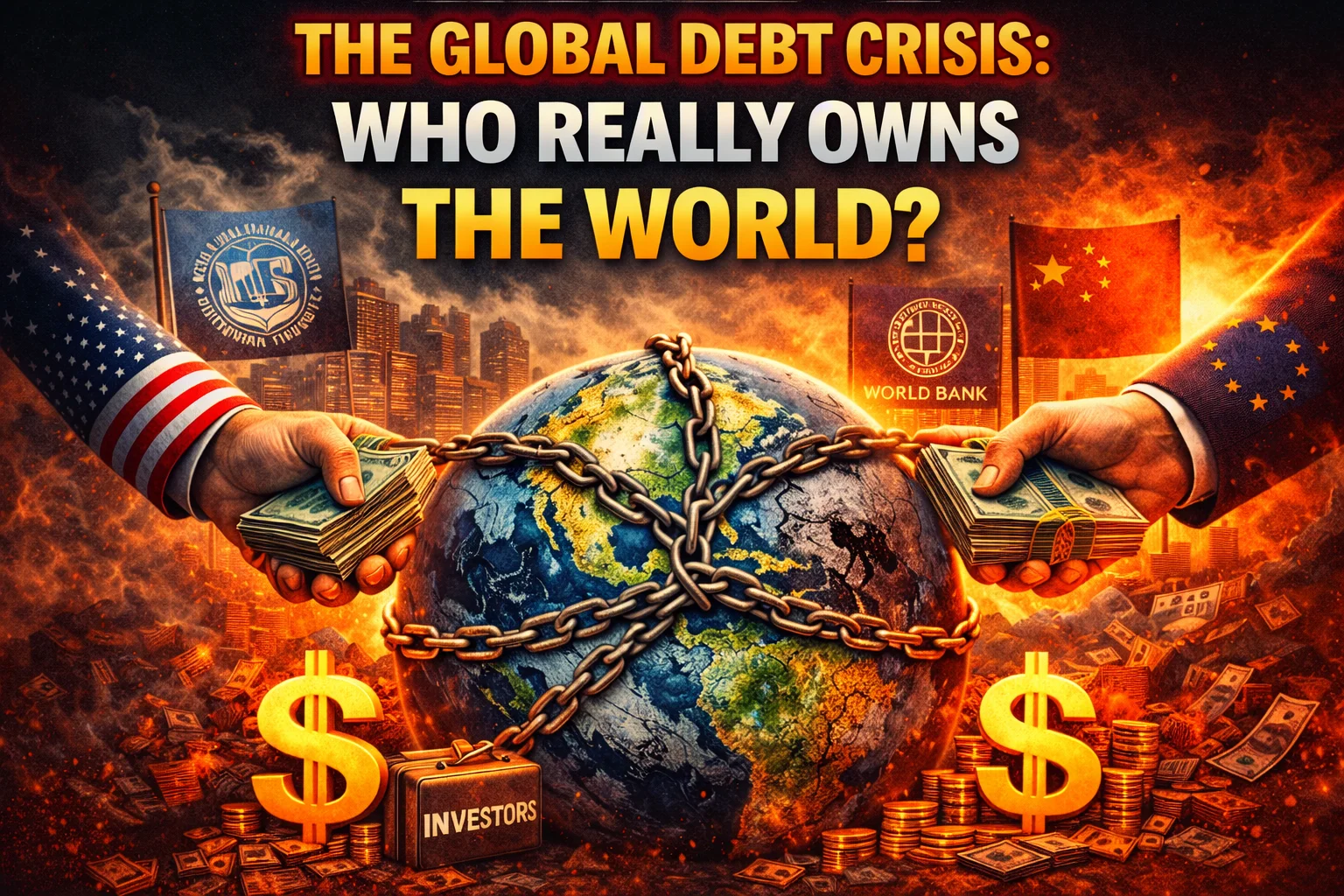
Governments borrow to fund budgets. Companies borrow to grow. Households borrow to buy homes, cars, phones. Add it all up and the planet owes far more than it produces in a year.
Which raises an obvious question — and one that gets answered badly more often than not. If almost everyone is a debtor, who is the creditor? Who is on the other side of all that borrowing?
The honest answer is less cinematic than the usual telling, and considerably more interesting.
The Numbers, With Actual Numbers
Vagueness is where bad explanations start, so let's be specific.
According to the Institute of International Finance, global debt reached a record $348 trillion at the end of 2025 — around 305% of world GDP. Roughly $29 trillion was added in a single year, the fastest build-up since the pandemic era. By mid-2026 the IIF's running total had climbed toward $353 trillion.
That figure covers three buckets:
| Category | What it is |
|---|---|
| Government debt | Bonds and loans issued by states to fund deficits |
| Corporate debt | Bonds, bank loans and private credit taken on by companies |
| Household debt | Mortgages, car loans, credit cards, personal loans |
So yes — the world owes about three times what it produces annually. That sounds alarming, and in places it is. But before drawing conclusions, it's worth understanding what the number is actually measuring.
Every Debt Is Also Someone's Asset
Here is the fact that reframes everything: debt does not exist in isolation. It is a two-sided entry.
Your mortgage is your liability. It is also an asset on your bank's books — and quite possibly, after securitisation, an asset inside a pension fund holding mortgage bonds. A government bond is a state's obligation and simultaneously somebody's retirement savings.
Global debt of $348 trillion therefore implies global credit assets of roughly $348 trillion, distributed across pension funds, insurers, banks, mutual funds, central banks, sovereign wealth funds, corporations and ordinary savers.
The planet is not collectively in debt to some external party. There is no off-world creditor. Debt is the internal wiring of the financial system — a record of who has deferred consumption and who has brought it forward.
That doesn't make it harmless. It does mean "the world owes more than it earns" is a claim about structure, not about impending collective bankruptcy.
So Who Are the Lenders?
Four groups matter. Their roles are frequently confused.
Central banks
Institutions like the U.S. Federal Reserve, the ECB and the Bank of Japan set short-term interest rates and can create reserves to buy assets — most often government bonds already trading in the market.
One correction worth making, because it appears constantly: central banks do not lend money directly to consumers or companies, and in most advanced economies they are legally barred from lending directly to their own treasury. They operate on secondary markets and set the price of money. That is enormous influence over borrowing costs everywhere. It is not the same as being the world's lender.
The Fed does hold a large slice of U.S. government debt — roughly $4.4 trillion, about 14% of debt held by the public — but it is one holder among many, and it has been shrinking that position since 2022.
Commercial banks
Banks create most of the money in circulation, and they do it through lending. When a bank issues a mortgage, it doesn't hand over someone else's deposit; it writes a new deposit into existence and books a matching loan. Repayment destroys that money.
This is genuinely how the system works, and it is genuinely under-taught. It is also constrained — by capital requirements, liquidity rules and the simple need for borrowers who can repay.
The IMF and World Bank
These lend to countries, typically when other options have run out. IMF programmes come with conditions: fiscal targets, policy reforms, structural adjustments.
This is the most contested part of the architecture, and the debate is real rather than hidden. Critics argue conditionality has repeatedly imposed austerity on countries least able to absorb it, deepening downturns and hollowing out public services. Defenders argue that a lender of last resort with no conditions is a subsidy for the policies that caused the crisis. Both positions have serious economists behind them.
Bond markets
This is the big one — and the least discussed.
Most government debt is not owed to the IMF or to foreign rivals. It is owed to investors: pension funds, insurance companies, mutual funds, banks, and households buying bonds directly.
Take the largest borrower on earth. U.S. federal debt passed $39 trillion in March 2026. Of the portion held by the public, roughly 30% sits with foreign holders — with Japan the largest at about $1.2 trillion, ahead of the UK and China — around 14% with the Federal Reserve, and the remaining 57%, some $17.9 trillion, with domestic investors: American pension plans, insurers, mutual funds, banks and savers.
Read that again, because it dismantles the framing the question usually arrives in. The single largest creditor to the United States is not a foreign power or a shadowy institution. It is the American financial system, holding assets on behalf of American retirees.
Where Debt Really Does Become Power
None of this means debt is politically neutral. It plainly isn't — but the mechanism is different from the one usually described.
Power in the debt system shows up as asymmetry of options.
A country that borrows in its own currency, which foreigners want to hold, can refinance almost indefinitely. Japan carries government debt above 200% of GDP and is not in crisis, because it borrows in yen from a deep domestic investor base.
A country that borrows in dollars it cannot print faces a different reality. When the dollar strengthens or global rates rise, its debt burden grows in real terms through no decision of its own. Refinancing becomes expensive or impossible. Then come the negotiations — with the IMF, with bondholder committees, with bilateral creditors — where the terms are set by whoever has the alternative.
The consequences are measurable. UNCTAD estimates that 3.3 billion people live in countries spending more on debt interest than on education or health. In close to 50 developing countries, more than 10% of government revenue goes to debt service. That is not a conspiracy. It is a structural feature of a system where the ability to borrow safely is distributed as unevenly as wealth itself — and it is a legitimate scandal.
Productive Debt vs. Destructive Debt
The useful distinction is not borrowing versus not borrowing. It is what the borrowing buys.
Productive debt funds something that generates future income or capacity: infrastructure, education, a factory, a business that grows. The return exceeds the interest, and the debt pays for itself.
Destructive debt funds consumption or plugs a hole. Nothing is created to service it, so it must be repaid from future income that has to come from somewhere else. Compound interest does the rest.
The same is true at every level. A mortgage on an affordable home is not a credit card balance rolled over at 24%. A bond financing a port is not a bond financing a fuel subsidy. Treating all debt as one thing obscures the only question that actually matters.
Why the System Persists
Because — for its participants — it works well enough.
Governments can borrow rather than tax, which is politically easier. Companies can grow faster than retained earnings allow. Households can own homes decades before they could save the purchase price. Savers get a return instead of cash under a mattress. Banks earn a spread.
A world without credit would not be freer. It would be poorer, slower, and far more tightly rationed by inherited wealth. The problems in the current system are real — excessive leverage, crises transmitted globally in days, and a sovereign debt architecture that fails poor countries repeatedly. Those are arguments for reform, not for pretending credit itself is the flaw.
The Answer
So: who owns the world?
Not one institution. Not a cartel. The claims on global output are held by pension funds managing retirements, insurers backing policies, sovereign wealth funds parking export revenue, banks intermediating deposits, and hundreds of millions of individual savers — with central banks setting the price at which all of it trades.
The concentration is real, but it lives elsewhere than the question implies. It is in who gets to borrow cheaply and who does not. Issuing the world's reserve currency is power. Having a deep domestic savings pool is power. Being forced to borrow in a currency you cannot print is the absence of it.
That is the genuine inequity in global finance — and it is documented in plain sight, in IIF monitors and IMF reports and Treasury data, for anyone who wants to look.
The uncomfortable truth about the debt system is not that it is hidden.
It is that it is public, and we have decided to live with it anyway.
Figures: IIF Global Debt Monitor (February 2026); U.S. Treasury and Treasury International Capital data (2026); UNCTAD. General information, not financial advice.