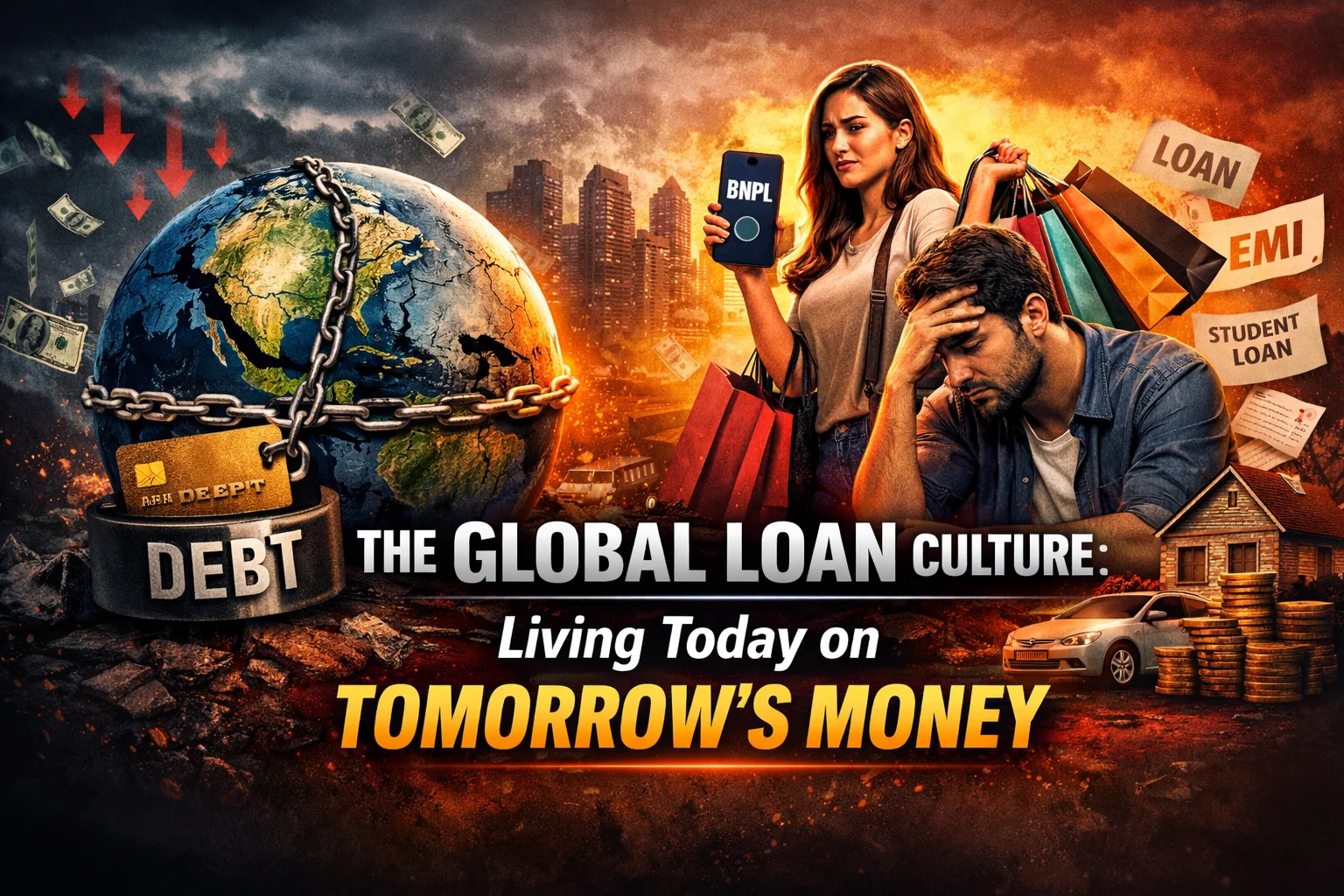
A 22-year-old buys a flagship phone. Not from savings — on EMI.
A young professional books an overseas trip. Not from surplus income — on a credit card.
A family upgrades its lifestyle. Not because the money is there, but because the financing is.
None of this is unusual. That is precisely the point worth examining. Borrowing has moved from being a contingency to being an operating mode — and the shift happened quietly enough that most people never chose it consciously.
What the Numbers Actually Show
Rhetoric about a debt crisis is easy. Figures are more useful.
In the United States, total household debt reached $18.8 trillion in the second quarter of 2026, according to the New York Fed's Quarterly Report on Household Debt and Credit. The breakdown is instructive:
| Category | Balance |
|---|---|
| Mortgages | ~$13.1 trillion |
| Auto loans | ~$1.69 trillion |
| Student loans | ~$1.65 trillion |
| Credit cards | ~$1.26 trillion |
Two details matter more than the headline total.
First, credit card balances are rising while mortgage and student loan balances fall. Housing debt buys an asset. Card debt usually buys consumption. The composition is shifting in the wrong direction.
Second, delinquency. Roughly 4.7% of outstanding household debt sits in some stage of delinquency, and in early 2026 auto loan delinquency hit the highest rate the New York Fed has ever recorded, with credit card delinquency near levels last seen around the 2008 crisis.
That is the signal. Not the size of the debt — the growing share of people who cannot service it.
Why Borrowing Became the Default
Credit got frictionless
A loan used to require a branch visit, documents, and a wait. Now it requires a tap.
Friction was never just bureaucracy. It was a pause — time in which a person could reconsider. Removing it improved access for millions who were previously excluded from formal credit, which is a real gain. It also removed the interval in which someone might have decided against the purchase. Both things are true, and the second rarely gets mentioned in the marketing.
The monthly-payment illusion
This is the single most effective technique in consumer lending, and it works on almost everyone.
₹3,000 a month sounds manageable. Over 24 months that is ₹72,000 — and if the item retails at ₹60,000, the extra ₹12,000 is what the convenience cost. Framed as a monthly figure, the purchase feels affordable. Framed as a total, it becomes a decision.
Sellers know which framing closes the sale. Almost nothing is advertised at its total cost.
Three questions defuse it:
- What is the total I will pay across the full term?
- What is the cash price?
- What is the gap — and is the item worth that gap to have now rather than later?
Sometimes the answer is yes. The point is to answer it deliberately.
Aspiration became visible and constant
Comparison has always driven spending. What changed is scale. Once, you measured yourself against neighbours and colleagues. Now the comparison set is global, curated, and available every waking hour.
Credit closes the gap between the life on screen and the income in the account. It does not close it for free.
Growth depends on consumption
Household spending drives a majority of economic output in most large economies. Governments and central banks therefore have a structural interest in keeping credit flowing — not through conspiracy, but through straightforward policy incentive. When spending slows, rates come down and lending is encouraged.
The system is built to reward borrowing. Recognising that is not cynicism; it is just knowing which way the current runs.
What It Costs
Compounding, running backwards
An investor earning 12% annually roughly doubles their money in six years. A borrower paying 36% on a revolving balance faces the same mathematics pointed the other way.
This is the most under-appreciated cost of consumer debt. It is not the individual purchase. It is the years of compounding you forgo while servicing it — the difference between an asset that grows quietly in the background and a liability that shrinks only when you attack it.
Income stops being yours
When enough of a salary is committed before it arrives, options narrow. Leaving a bad job becomes risky. Taking a pay cut for better work becomes impossible. Starting something becomes unthinkable.
The heaviest cost of debt is often not financial at all. It is the loss of the ability to say no.
The stress is real and documented
Financial strain is consistently associated with anxiety, sleep disruption and depression in research across multiple countries, and the relationship appears to run in both directions — debt worsens mental health, and poor mental health makes financial decisions harder.
This deserves saying plainly, because the shame around debt keeps people from seeking help. Struggling with repayments is a common financial situation, not a character defect. Lenders, credit counsellors and debt advice services exist precisely for it, and the earlier someone makes contact, the more options remain.
The Global Picture
This is not confined to one country.
India has seen Buy Now Pay Later expand at roughly a 34% compound annual rate between 2022 and 2025, concentrated among younger and new-to-credit borrowers. The Reserve Bank of India has since tightened its digital lending framework, requiring clearer disclosure, more frequent credit bureau reporting and explicit accountability for the lender of record — largely because small, invisible loans were accumulating faster than any single lender could see.
China spent years channelling household savings into property, and the resulting developer leverage produced a correction whose effects are still working through the economy.
The United States shows the mature version: enormous absolute balances alongside rising distress in the unsecured categories.
Different markets, different products, the same underlying pattern — consumption pulled forward faster than income grew to meet it.
A Fairer Reading of the System
It is tempting to conclude that lenders want borrowers permanently trapped. The reality is more specific, and more useful to understand.
Defaults are expensive; lenders write off the principal. What lenders profit from is the performing revolver — the customer who never misses a payment and never clears the balance. That is the most valuable relationship in consumer credit, and product design reflects it: minimum payments set low, limits raised automatically, rewards that encourage volume.
The incentive is not to break you. It is to keep you comfortably paying interest indefinitely. That is a more precise description than any conspiracy, and it points at a more practical defence: pay more than the minimum, always. The minimum payment is designed for the lender's return, not your balance.
Good Debt, Bad Debt
The question is never whether to borrow. It is what the borrowing buys.
Debt that tends to work: a mortgage on a home you can afford; education with a realistic path to higher earnings; capital for a business with genuine demand; anything that produces income or capability exceeding its interest cost.
Debt that tends not to: depreciating goods bought on revolving credit; lifestyle spending financed on expectation of a raise; borrowing to repay other borrowing; anything where the item's value falls faster than the balance.
Two useful tests. Would you still want this if nobody could see it? And could you cover the payment if your income dropped by a third?
The Honest Conclusion
Credit is not a trap laid for the unwary. It is a genuinely useful tool that most people are handed with no instruction and considerable encouragement.
A world without consumer credit would not be freer. It would be one where only inherited wealth bought a house, funded a degree, or started a company. The problem is not the existence of lending. It is that the marketing of credit is sophisticated, universal and well-funded, while the education about it is patchy, boring and mostly absent.
Which leaves the defence in one place: the borrower's own arithmetic.
Before the next loan, three questions:
- What is the total cost, not the monthly one?
- Does this buy something that grows, or something that fades?
- Could I still make this payment if my circumstances changed?
Answer those honestly and borrow anyway, and you have made a decision. Skip them, and the decision has been made for you.
Figures: Federal Reserve Bank of New York, Quarterly Report on Household Debt and Credit (Q1 and Q2 2026); India BNPL growth estimates from market research cited January 2026; Reserve Bank of India digital lending framework. General information, not financial advice. Anyone struggling with repayments should contact a regulated credit counselling service in their country.