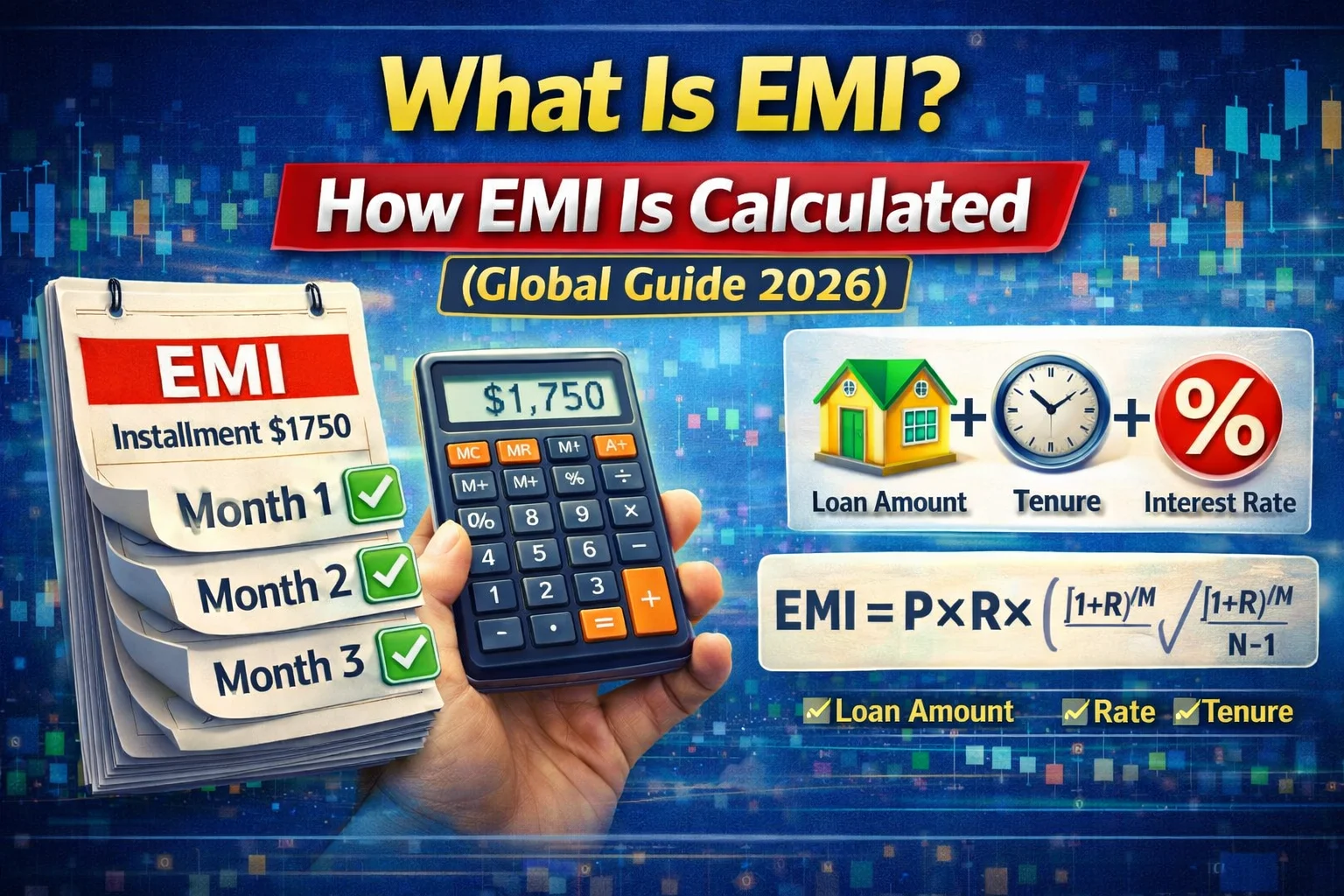
EMI stands for Equated Monthly Installment — the fixed sum you pay each month to clear a loan. Every payment covers two things: part of the amount you borrowed (principal) and the charge for borrowing it (interest).
The concept is simple. What most guides skip is the part that costs people money: the EMI figure is the single most misleading number in consumer lending, because it can be made to look small in ways that make the loan far more expensive.
This guide covers the formula, a worked example you can verify, and the four things the monthly figure conceals.
The Formula
Where:
- P = principal, the amount borrowed
- r = monthly interest rate = annual rate ÷ 12 ÷ 100
- n = tenure in months
The division by 100 matters. For a 12% annual rate, r is 0.01 — not 1.
Worked example. Borrow $10,000 at 12% annually over 24 months:
- r = 12 ÷ 12 ÷ 100 = 0.01
- n = 24
- (1.01)24 = 1.26973
- EMI = 10,000 × 0.01 × 1.26973 ÷ 0.26973 = $470.73
Total repaid: $11,297.63. Total interest: $1,297.63.
In a spreadsheet, =PMT(0.01, 24, -10000) returns the same figure.
Thing One: Longer Tenure Is Not a Way to Reduce Cost
Most EMI guides list "choose a longer tenure" as a tip for reducing your burden. It reduces the monthly figure. It increases what the loan costs, often enormously.
A home loan of ₹50,00,000 at 8.5%:
| Tenure | Monthly EMI | Total interest paid |
|---|---|---|
| 10 years | ₹61,993 | ₹24.4 lakh |
| 15 years | ₹49,237 | ₹38.6 lakh |
| 20 years | ₹43,391 | ₹54.1 lakh |
| 25 years | ₹40,261 | ₹70.8 lakh |
| 30 years | ₹38,446 | ₹88.4 lakh |
Read the two ends together. Extending from 10 years to 30 years lowers the monthly payment by about ₹23,500 — and raises total interest by roughly ₹64 lakh, more than the original loan.
Notice also the shape: the EMI saving shrinks with each extension while the interest cost keeps climbing. Going from 25 to 30 years saves under ₹1,900 a month and costs ₹17.6 lakh more.
The correct framing: tenure is an affordability tool, not a savings tool. Take the shortest tenure whose EMI you can comfortably service — and if that's tight, consider whether the purchase itself is the right size.
Thing Two: Flat Rate vs Reducing Balance
This is where the largest mis-selling happens, particularly on personal loans, consumer durable finance and vehicle loans.
Under reducing balance (how the EMI formula above works), interest is charged on what you still owe. As the balance falls, the interest portion falls.
Under a flat rate, interest is charged on the original amount for the whole term, regardless of how much you've repaid.
Compare directly. Borrow ₹1,00,000 for 3 years, quoted at "10% flat":
- Interest = ₹1,00,000 × 10% × 3 = ₹30,000
- EMI = ₹1,30,000 ÷ 36 = ₹3,611
That same EMI on a reducing-balance loan corresponds to an effective rate of approximately 17.9%.
A 10% flat rate is roughly an 18% real rate. The rough rule: a flat rate is close to double the equivalent reducing-balance rate over typical tenures.
Always ask which basis is quoted. If a lender won't say plainly, ask for the annualised percentage rate instead — that figure is comparable across products.
Thing Three: The Advertised Rate Isn't the Cost
Beyond interest, most loans carry charges that don't appear in the EMI at all:
- Processing fee — commonly 0.5% to 2% of the loan, often deducted at disbursement, meaning you receive less than you're paying interest on
- Documentation and legal charges
- Insurance bundled into the loan — sometimes financed, so you pay interest on the premium too
- Prepayment or foreclosure charges where applicable
- Late payment penalties and bounce charges
The comparable number across lenders is the annualised percentage rate — APR, or in India the annual percentage rate shown on the Key Fact Statement, which RBI requires regulated lenders to provide for retail loans. It folds fees into a single figure. Two loans quoting the same interest rate can carry meaningfully different APRs.
Compare APR to APR. Never rate to rate, and never EMI to EMI.
Thing Four: Early Payments Are Almost All Interest
The EMI stays constant, but its composition changes dramatically.
On that ₹50 lakh, 20-year loan at 8.5% with an EMI of ₹43,391:
| Period | Goes to interest | Goes to principal |
|---|---|---|
| Year 1 (12 payments) | ₹4,21,182 | ₹99,511 |
| Year 20 (12 payments) | ₹23,202 | ₹4,97,492 |
In the first year, about 81% of every payment is interest. After paying for ten years — half the term — you still owe roughly 70% of the original loan.
Two practical consequences. First, leaving early in a home loan means you've built far less equity than the years suggest. Second, prepayments made early are worth far more than prepayments made late, because they remove principal that would otherwise accrue interest for the entire remaining term.
Concretely: a one-time prepayment of ₹2,00,000 at the five-year mark on that loan saves about ₹4.5 lakh in interest and clears the loan 15 months early. The same amount paid in year 15 saves a fraction of that.
Fixed vs Floating
| Fixed | Floating | |
|---|---|---|
| EMI | Constant through the term | Changes as the benchmark moves |
| Starting rate | Usually higher | Usually lower |
| Rate rises | You're protected | You absorb it |
| Rate falls | You don't benefit | You benefit |
| Prepayment (India, individual borrowers) | Charges may apply | No foreclosure charges on floating-rate loans |
That last row is worth knowing: RBI prohibits banks and NBFCs from levying foreclosure charges or prepayment penalties on floating-rate term loans taken by individual borrowers for non-business purposes. Confirm current rules and whether your specific loan qualifies before relying on it.
One mechanic that catches floating-rate borrowers out: when rates rise, many lenders extend the tenure rather than raise the EMI. Your monthly payment looks unchanged, but you're now paying for years longer. If your rate moves, ask explicitly which one changed — and consider asking for the EMI to rise instead, if you can afford it.
For scale: on that ₹50 lakh 20-year loan, a rate move from 8.5% to 9.5% raises the EMI by about ₹3,215 a month.
Before You Sign: A Checklist
- Ask for total repayment, not EMI. Principal plus all interest plus all fees. This single question reframes most loan decisions.
- Confirm flat or reducing balance. If flat, roughly double the quoted rate to compare fairly.
- Get the APR in writing, and compare it across at least three lenders.
- Read the prepayment terms before signing, not when you want to prepay.
- Take the shortest tenure you can comfortably service. Comfortably means the EMI still works if your income drops.
- Check the processing fee treatment — deducted upfront or added to principal changes what you actually receive.
- Verify the calculation yourself. Use
=PMT(rate/12, months, -principal)in any spreadsheet and check it matches the lender's figure.
Common Questions
Is a lower EMI better?
Only if it comes from a lower rate or a smaller loan. A lower EMI from a longer tenure means you pay substantially more overall.
Can my EMI change?
On a floating-rate loan, yes. Note that some lenders adjust tenure instead of EMI — ask which happened.
Should I prepay or invest instead?
Compare your loan rate against the after-tax return you'd realistically earn. Prepaying a 9% loan is a guaranteed 9% return; few investments offer that risk-free. Where a loan carries tax benefits, factor those in.
Does a better credit score reduce my EMI?
Indirectly. It qualifies you for a lower rate, which lowers the EMI. Check your score and correct any errors before applying, not after.
Which loans use EMI?
Home, vehicle, personal, education and consumer durable loans. Credit cards work differently — a minimum payment is not an EMI and can leave a balance outstanding indefinitely.
All calculations verified using the standard reducing-balance EMI formula. Illustrative rates only — use your actual quoted figures. Regulations including RBI prepayment rules change; confirm current terms with your lender. General information, not financial advice.